


Labour laws in Nepal are considered modern and worker-friendly.The Labour Act 2074 and the Contribution-Based Social Security Act 2074 provide rules about wages,working hours,safety,and social security.However,there is a big difference between what the law says and what actually happens in real life.
Firstly,the law provides several important protections for workers. It sets a minimum monthly wage of around NPR 19,550 and limits working hours to 8 hours per day and 48 hours per week.If workers do overtime,they should be paid 1.5 times their normal wage.In addition,workers are supposed to be included in the Social Security Fund, which provides support during illness,maternity,accidents,and old age. The law also gives different types of leave,such as sick leave, maternity leave,and paternity leave.Moreover,most workers should have a written contract that clearly explains their job,salary, and benefits.
However,in practice,many workers do not receive these benefits. A major reason is that a large number of people in Nepal work in the informal sector,such as agriculture and construction.These workers often do not have written contracts and are not included in the social security system. As a result,they are not fully protected by the law.
Another problem is weak enforcement.Labour offices do not always have enough.staff or resources to check whether employers are following the law.In some cases, corruption also affects proper implementation. Because of this,even formal rules are not properly followed.
Furthermore, many Nepali workers go abroad for employment, especially to countries like Malaysia and the UAE. These migrant workers often face exploitation, unfair treatment, and lack of legal support, even though there are laws to protect them..
Finally, lack of awareness is also a serious issue. Many workers, especially in rural areas, do not know their rights. Because of this, they cannot complain or take legal action when they are treated unfairly.
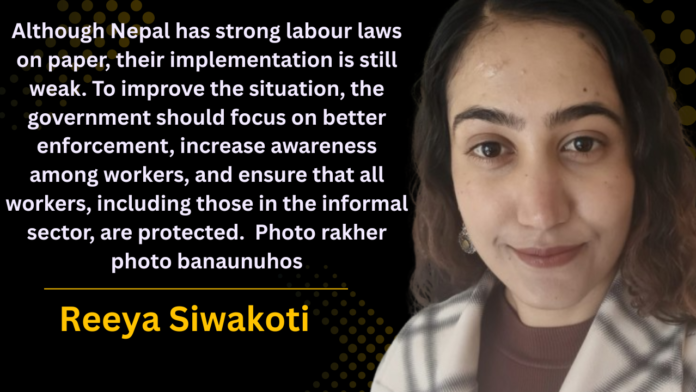
In conclusion, although Nepal has strong labour laws on paper, their implementation is still weak. To improve the situation, the government should focus on better enforcement, increase awareness among workers, and ensure that all workers, including those in the informal sector, are protected.
Real-Life Cases of Labor Challenges in Nepal
Despite labor laws intended to protect workers, many laborers in Nepal continue to face exploitation and unsafe working conditions. In Kathmandu’s construction sector, workers like Bhim Bahadur carry heavy materials for 10-12 hours a day whilehelping build houses or hotels, yet they often lack written contracts, are paid in cash, and are not registered in the Social Security Fund. If contractors refuse to pay or disappear, these workers have almost no legal recourse, highlighting the gap between law and practice (Legal Access Nepal, 2026).
Similarly, in castern Nepal’s tea estates, workers endure long hours in the fields for very low wages. Many live in housing provided by the estates, yet their pay is historically lower than other sectors, and retirement payments are insufficient to support a stable life. As a result, families are often forced to continue working in the same estates generation after generation, demonstrating that labor laws have not fully addressed wage inequality (Kathmandu Post, 2026; Nepals Journal Online, 2026).
Domestic workers, mostly women and girls in urban households, are another group facing severe underprotection. They often work from early morning until evening, performing multiple household tasks without a fixed schedule, paid leave, or minimum wage. Instances of fines for minor mistakes further underscore their vulnerability, such as a worker being fined NPR 500 for accidentally breaking a vase, a significant portion of her salary. These cases collectively reveal that, despite existing legislation, many laborers remain highly undervalued and largely unprotected (Record Nepal, 2026).
In the end, the story of Nepali workers, both at home and abroad is not just about statistics, but about survival, sacrifice, and silent resilience. Behind every low wage, every unsafe workplace, and every migrant departure is a person trying to secure dignity for themselves and a better future for their family. While remittances continue to sustain the national economy, they come at a deeply personal cost of separation, debt, exploitation, and, in too many cases, loss. The reality is clear: foreign employment has become less of an opportunity and more of a necessity born out of limited choices at home. If meaningful change is to occur, it must go beyond policy promises and address the lived experiences of workers ensuring not just economic contribution, but safety, dignity, and justice for those who carry the burden of the nation’s growth.
(“Reeya Siwakoti is a fifth-year B.A.LL.B student at Kathmandu School of Law (KSL). She has a strong interest in law and social justice and writes on contemporary legal issues and labor rights.”)


